




















Wuthering Heights is a gothic tragedy novel written by Emily Brontë, published in 1847 under the pseudonym Ellis Bell. It is an intense, chaotic, and passionate novel filled with violence and death. No character is likable or relatable; they are irritating and self-serving. It is a renowned classic for that very reason, and while most readers finish it and never wish to pick it up again, it is the fact that it was worth reading in the first place that matters. So when Emerald Fennell announced she was creating a “Wuthering Heights” adaptation featuring big names like Margot Robbie and Jacob Elordi, it piqued not only viewers’ but also readers’ interest in the direction she would go based on her past works like Saltburn and Promising Young Woman
Fennell is an English actress, filmmaker, and writer who has won multiple awards, including an Academy Award, two
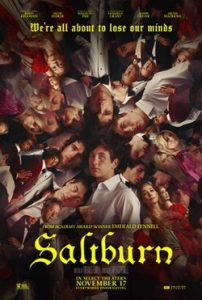
BAFTAs, three Emmys, and three Golden Globes. She had been working on multiple large productions, but the one that drew the most attention was the movie Saltburn, directed by Fennel herself. When it first played in theaters, viewers were drawn to it by the beautiful cinematography and star-studded cast filled with twists and turns. Though as time went on, opinion changed, it became seen as shallow and vapid, with aesthetics prioritized over plot; one of the main themes was British classism and an “eat the rich” narrative. But Emerald Fennell is rich. She is often grouped with the term “nepotism baby” due to her parents’ wealth and connections. So to say audiences felt Fennell wasn’t quite the person to deliver this message would be an understatement; a very similar statement could be applied to Wuthering Heights, and may be the reason the film missed the mark.
Wuthering Heights, at its core, is about generational trauma, destructive love, and revenge. The novel starts in 1801 with our primary narrator, Lockwood, writing in his diary about arriving at Thrushcross Grange, an isolated manor in England. He pays a visit to his landlord, Mr. Heathcliff, at Wuthering Heights. In this nearby ancient manor, he meets the housekeeper, Nelly Dean, whom he asks about Heathcliff’s story, which he proceeds to write in his diary, forming most of the novel.

The story goes as follows: Mr. Earnshaw returns home with a dark-skinned orphan boy (Heathcliff) to his two children, Catherine and Hindley. Both despise him, though young Catherine comes to love him, and they spend their youth inseparable, exploring the moors. Three years later, Mr. Earnshaw dies, allowing Hindley to inherit Wuthering Heights and enact his revenge against Heathcliff for his close relationship to his father. A wealthy family builds Thrushcross Grange nearby, where two children, Edgar and Isabella Linton, come to live. Catherine, desiring social advancement, becomes engaged to Edgar, causing Heathcliff to run away for three years. When he returns, Heathcliff has become very wealthy and causes Hindley’s death to inherit Wuthering Heights and marries Isabella Linton, whom he violently abuses, leading her to escape to London with their son, Linton. Catherine becomes very ill and dies in child birth of her daughter, Cathy. Heathcliff goes mad as Catherine’s ghost haunts him. Linton returns from London, and Heathcliff forces him to deceive Cathy into marrying him to inherit Thrushcross Grange in a plot of revenge against Edgar. The plot works, and Linton dies from illness, leaving Cathy alone and a prisoner to Heathcliff.
Lockwood is appalled by the story and immediately leaves Thrushcross Grange. He returns six months later to visit Nelly and learns in his absence that Heathcliff descended into madness and was speaking to Catherine’s ghost, and spent the nights wandering the moors looking for her, causing him to die. During Cathy’s captivity, she fell in love with Hindley’s son, Hareton, and after Heathcliff’s death marry and inherited Wuthering Heights and Thrushcross Grange.
Now imagine this story stripped of everything dark, depraved, and meaningful. The movie has removed Hindley and his unrelenting abuse toward Heathcliff, as well as the second generation of Cathy, Linton, and Hareton. This destroys the importance of generational trauma within the novel and the impact it has on every character’s motives and actions. Lockwood is removed as well, scraping the frame narrative and Nelly becoming an active participant rather than a distant storyteller. The atmosphere as a whole is changed from dark and gloomy to vibrant and stylized, betraying the title as wuthering refers to strong wind, often from stormy weather, which often creates haunted and desolated imagery. Though the two most ruinous changes are the mischaracterization of Isabella Linton and Heathcliff.
Isabella Linton is perhaps the strongest character within the novel, surviving Heathcliff’s never-ending abuse after
being tricked into believing he was loving and kind. She escaped to safety with her child until her death, which was very rare for the time to be able to get out of such a marriage. To erase her grit and willpower is to erase her as a character. Fennell saw Isabella and decided to torture her further by making her an eager, consenting participant in a different form of violence. In the novel, Heathcliff hangs and kills Isabella’s dog; in the movie, Isabella becomes the dog. This story change not only harms Isabella but also redeems Heathcliff and pushes him further into the romantic hero he wasn’t written to be: “She abandoned them under a delusion, picturing in me a hero of romance.” Fennel chose to erase Heathcliff’s villainous behavior and inner makings, but she didn’t stop there; she also erased his racial ambiguity.

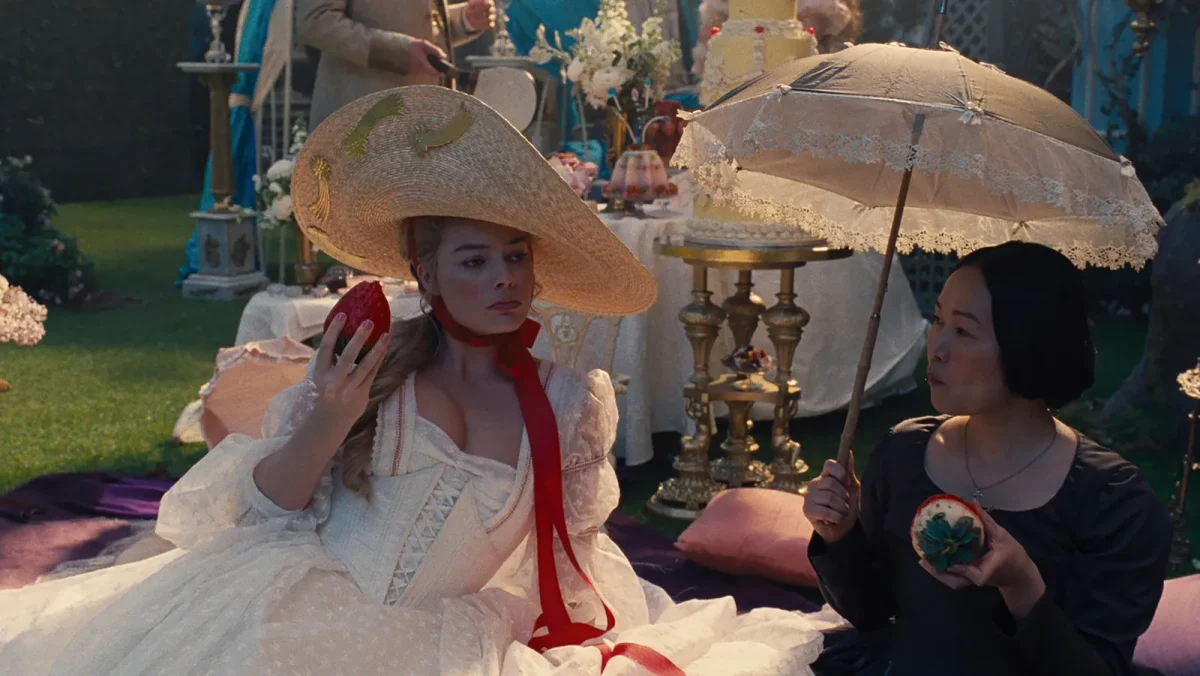
Throughout the novel, Heathcliff is described as dusky with black hair and dark skin and is treated as an “it”. This is a pivotal point within the novel because it jumpstarts Hindley’s and Catherine’s dislike of him and the abuse he endures after Mr. Earnshaw’s death at the hands of Hindley. His race is a crater between Catherine and himself, and the reason they can’t get married or fulfill Catherine’s desire for status. Fans weren’t quiet about their wishes for a brown Heathcliff, with Dev Patel, who starred in the British series Skins and became more widely known from his movie Monkey Man, being their number one fan cast. Casting Jacob Elordi, an objectively attractive white man, known for his looks, comes off as extremely superficial and strips the story of its richness. Fennel also decided to cast the two main villains of the film as people of color, though in the novel they are both originally white, Catherine’s ladys maid, Nelly Dean, who judges Catherine for her interest in Heathcliff, is played by Hong Chau, a Thai-born American actress. Edgar Linton, Catherine’s stifling husband, is played by Shazad Latif, a mixed Pakistani man. Politics plays a huge role in the backlash, with Bronte herself writing the story to critique the politics of her time, to erase the component of race is ignorant of the problems of today. Audiences yearn for representation and inclusion; this would have been a huge moment for Fennel to create something for them and for readers. It gives the impression that Fennel didn’t grasp the novel or care enough to be faithful in her adaptation, which raises the question, why adapt at all?
Adaptations are overdone. People are tired of sequels, prequels, and recreations; they want something new and original

to fall in love with. The changes Fennel made to the film practically turn it into a new story altogether and could have survived as an original, drawing inspiration from Wuthering Heights. It would have made the changes less harsh and upsetting if she had changed the title, the characters’ names, and the location slightly. She would have been applauded for putting something fresh into the industry and pulling readers in through the interest of her inspiration from the novel and creative choices.
This isn’t to say the movie is a bad film; it is emotional and relatable to modern girls and women who have experienced a love similar to Catherine’s and Heathcliff’s, but it isn’t Wuthering Heights. It is just another example of the film industry making an adaptation and stripping it of all the original qualities that make people gravitate to the novel. If it is an adaptation, do it right, analyze the characters, motives, setting, and core topics that support the story, and if not, make something original for once.