











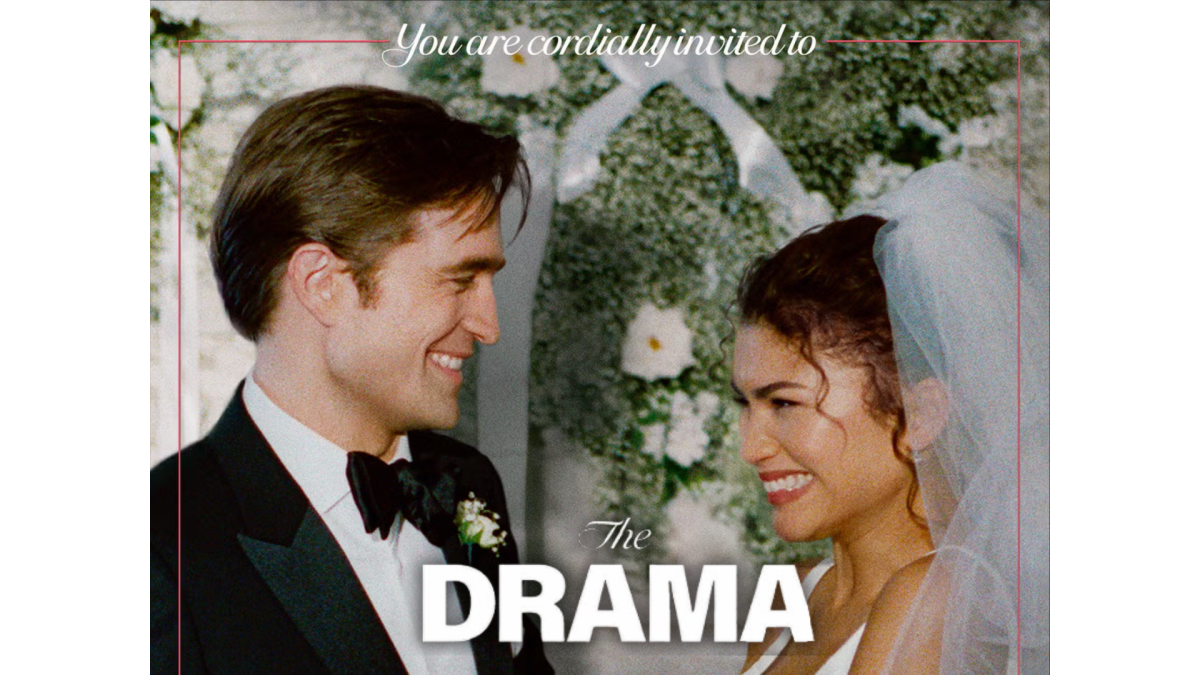
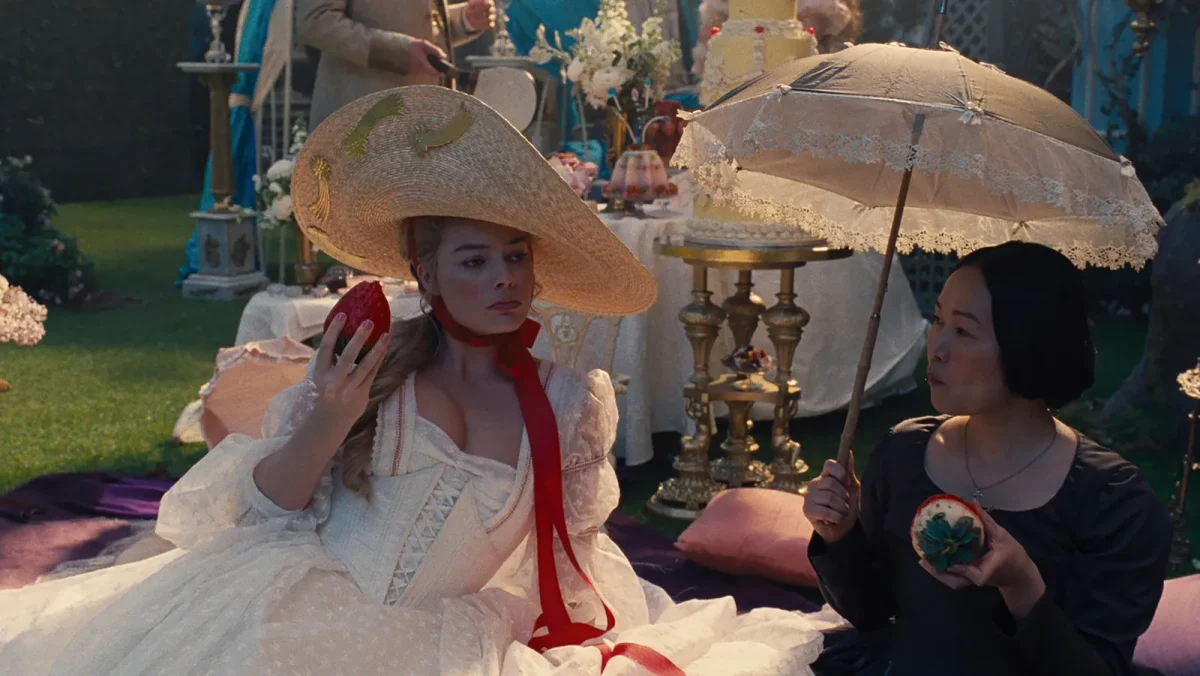




The Drama is an A24 film starring Zendaya and Robert Pattinson about a happily engaged couple who face a devastating truth the day before their wedding that could ruin everything. It is a psychological thriller-romance that explores hypocrisy, trust, and the secrets kept within relationships. It was marketed as a romance with cute Polaroid pictures of the couple and wedding photoshoots. But the film’s true themes were hidden beneath the facade of a cozy rom-com.
The film starts a week before Charlie and Emma’s wedding, with how they first met, it then skips to their first date and

other times they’ve spent together, ending with Charlie working on writing his speech. Their relationship seems perfect, picturesque, until they go to a dinner tasting with their friends Mike and Rachel. The conversation starts lightly about things Mike and Rachel did when they first got married, like telling each other the worst thing they have ever done and agreeing to never talk about it again. This is when the audience first gets a glimpse of Rachel’s character and sets her up to be the “main villain” of the film, since she was the one to bring up Mike’s secret and force him to share it with the group, with no intention of sharing hers. Mike confesses he used his ex-girlfriend as a human shield to fight off a rabid dog, Rachel shares she locked a mentally disabled boy in a closet in the woods and left him there, and Charlie laughs as he quickly says he cyberbullied a boy so bad his family had to move towns. The camera then turns to a nervous-looking Emma, who blurts out that she planned a mass shooting at her high school but never went through with it. The film follows the fallout of the secret being unveiled, and just how much some people can forgive to save their relationship.

A main conversation online after viewing the film is about Rachel as an antagonist, and how she fuels the group’s turn on Emma, turning her secret into something terrible that she should be punished and ostracized for. Rachel is first seen having lunch with Emma and another friend, discussing what Emma should include in her speech. Emma is crying thinking about their love story, and Rachel says she shouldn’t cry at her wedding because she’s an ugly crier. This scene isn’t a great first impression, so when she has the biggest reaction to Emma’s secret, the audience is already annoyed and on Emma’s side, without listening to Rachel. But that isn’t to say Rachel was right in her reaction. She keeps repeating how her cousin was paralyzed and disabled from a school shooting, making it seem like Rachel herself is the victim, but she also locked a disabled boy in a closet, possibly killing him. She gives a speech at the wedding, saying that they deserve each other because they are so open-minded and understanding, with a scowl on her face. She is constantly antagonizing other characters, including her husband Mike, who is passive in the situation and often hides behind her and her opinions.
Mike is against Emma, but has some sympathy for her and wants to hear Charlie out in defending her. But he doesn’t

have the energy to stand up to Rachel or share what he thinks; he never says anything of quality or that impacts the plot. The only time he stands up to Rachel is when Charlie is defending Emma, saying that she grew up around guns and in a bad part of town. Rachel retorts that so did Mike, but he quickly corrects that he’s never been close to a gun, and his family didn’t own any. Rachel’s comment is pointed because Emma and Mike are both people of color, so saying they both grew up with weapons and in bad areas was racially targeted and seems to be the only thing Mike is willing to stand up to, as well as another reason for the audience to dislike Rachel.
 Other than creating Rachel as the villain, the film uses other things to put Emma in a better light and make the viewers on her side, such as having the other characters keep acting in line with their worst actions. Rachel is constantly attacking people and abandoning them, as she did to the disabled boy. Mike hides behind Rachel just like he did with his ex-girlfriend when they were attacked by a rabid dog. Charlie never takes anything seriously, like how he didn’t take forcing a boy to move towns because he cyberbullied him seriously. That’s why, when they are all so critical of Emma, the audience gets upset because she never did anything; she just thought about doing something.
The movie touches on thought crimes and the aestheticism of mass shootings created by social media in America.

Charlie forces Emma to explain in hopes that she had a “good” reason to commit the shooting, but Emma didn’t have a reason. She was an impressionable teen who was bullied and isolated, had absent parents, and a gun was available because her father was in the military. She fell victim to social media propaganda of gun violence and wanted a way to have control over the people who made her feel small. But to Charlie, that isn’t good enough since he’s British and doesn’t fully understand America’s political climate and the impact it has on children. Though that doesn’t mean Charlie doesn’t try to understand, it’s clear he loves Emma and wants to be able to defend her to their friends, but struggles to defend using the truth. On multiple occasions, he lies and says she saw her best friend die in a car accident, and never got therapy, just to create a reason that is more forgivable in his eyes. In the end, Charlie does find a way to forgive Emma, but it requires him to do something worse.
Charlie becomes the main character after their secrets are exposed, and it follows him working through Emma’s past

and trying to get over what he believes to be moral. It isn’t until he is being comforted by his coworker Misha that he kisses her, and they almost take it too far until he realizes he might not know what’s right and wrong. At the reception, Charlie confesses to cheating on Emma and gets punched by Mishas boyfriend in front of everyone. Emma runs and ghosts Charlie while he calls her from their empty apartment. Earlier in the film, Emma commented on going to their favorite dinner after the wedding to get burgers, which Charlie shut down. But now, defeated and dejected, he walks alone to the dinner and sits down at an empty booth. Emma walks in a few minutes later and sits in front of him, “Hi, I’m Emma. I live two blocks from here and haven’t seen you around before. What’s your name?” Emma looks at him silently, begging him to play along so they can try again. Charlie, now understanding he no longer has the moral high ground, responds, “Hi, I am Charlie”.
The Drama is not just for shock factor, but makes viewers think deeply
 about what they would and would not forgive in their partner. The film gives an example of the worst-case scenario, but a good outcome for the main couple. It’s complicated and intense, forcing the audience to work through their own moral beliefs and standards with Charlie to determine whether they would forgive Emma, too. There is no easy way out or simple answers, making viewers uncomfortable and setting The Drama apart from other recently released films. It’ll linger and be stuck in your mind, your opinion constantly changing, and if that doesn’t make a good movie, what does?